
Over the past few weeks, I’ve been focused on one of the most important things I do as a farmer – plan for the coming year.
This process starts with determining what crops will be grown in which beds. In order to break up pest and disease cycles, we never grow the same crop in the same bed two years in a row. Different crops have different rooting depths and nutrient and fertility needs, so crop rotation is also important for maintaining maximum fertility throughout the farm. We like to use a two or three-year rotation, meaning that we don’t grow crops in the same family in a particular bed without a two- or three-year break. With over 60 annual vegetable beds at the farm, you can imagine this is quite a puzzle to solve.
Once I’ve decided what crops will grow where, using big laminated graph paper and dry erase markers, then all of the information gets translated to an Excel spreadsheet. The spreadsheets show which crop goes where, when it will be planted, how far apart each plant will be, how many plants will be in each bed, and when the crop will be harvested (ideally – nature does not always cooperate).
Then comes the fun part – selecting and sourcing the right seeds. Not all broccoli, cabbage or tomatoes are the same, and choosing the right varieties to grow is essential for a bountiful harvest. After 10 years of farming, I have a pretty good idea of what works, but there are always new varieties to consider.
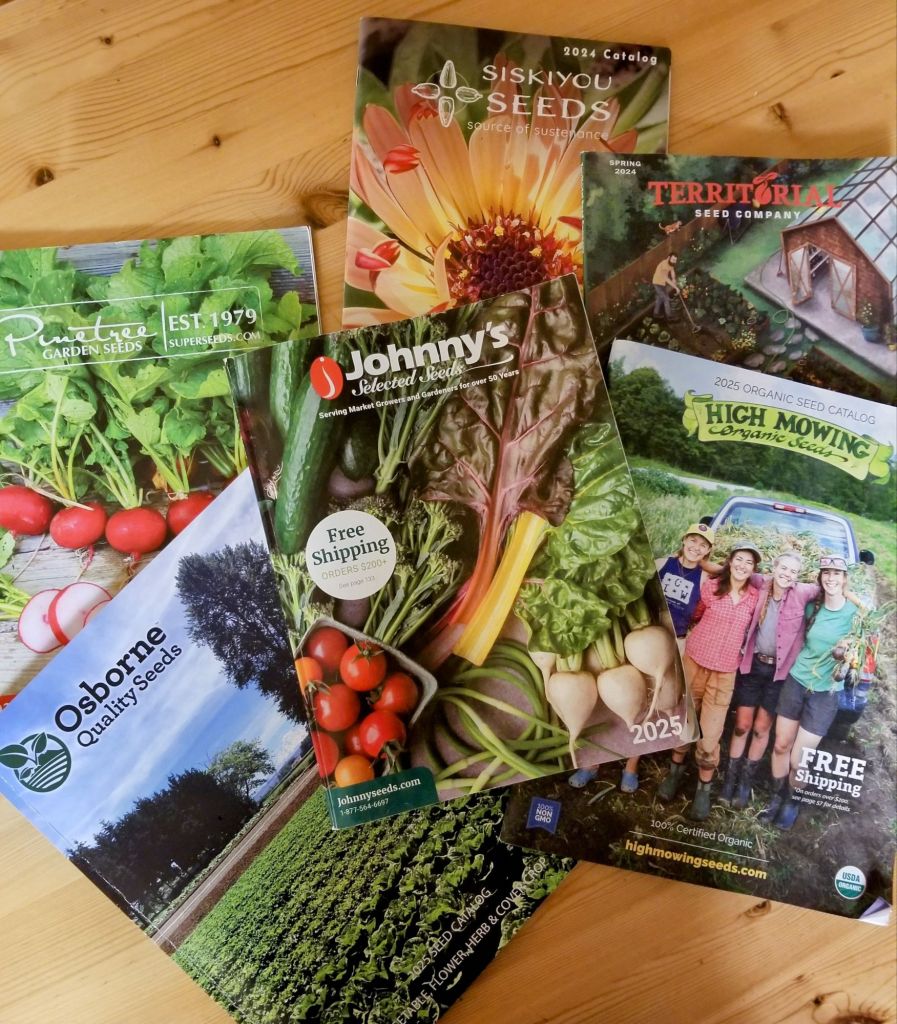
I purchase most of my seed from Johnny’s Seeds and Osborne Seeds, but on occasion also buy from Territorial, Baker Creek, Adaptive, High Mowing, Pinetree and Siskiyou. This year I have also been looking into several small Washington-based seed companies – Saltwater Seeds and Uprising Seeds.
Prowling through seed catalogues is fun, but can also be overwhelming, as you compare different companies, different varieties and different prices. One of my pet peeves is that some companies price based on the number of seeds, and other by weight, so I constantly find myself comparing whether Johnny’ Lacinato kale, priced by the number of seeds, is more or less expensive than Osborne’s Lacinato priced by the ounce (yes, you need to determine how many kale seeds are in an ounce!). Some companies are worse – they don’t even tell you how many seeds are in a packet.
One thing has been very obvious this year. The price of seeds has increased dramatically. In some cases, its more than doubled over the last year! Several varieties I have purchased in the past are identified in the catalogues as not available due to “crop failure”. At a recent conference, when I spoke with several seed reps from different companies, they all had the same explanation for higher prices and limited availability: Climate Change.
As someone who has actively paid attention to Climate Change since the 1980’s, I’ve understood that a warming planet would reduce crop yields. I had never considered its impact on seed yields, but reality has set in fast. Increased wildfires, hurricanes, tornadoes and flooding are reshaping farming realities today, and will continue to do so long into the future.
Over the past few years, I have also noticed a disturbing trend in seeds – germination rates are falling. Germination rate is the number of seeds that actually germinate. For example, a germination rate of 90% means that 9 out 10 seeds will germinate. It used to be that it was rare to see germination rates of less than 80%. Last year some of the seed I purchased had germination rates less than than that same variety had in previous years. For some things I was seeing rates less than 70%. This means you have to buy more seed to wind up with your desired number of plants, which also increase costs. Not all seed companies tell you the germination rates in their catalogue, or on the seed packet. Look for companies that do – like Johnny’s and Osborne.
So, what can a farmer or gardener do? First, secure the seed you need for next year soon, when it is still available. Look for high germination rates. Consider purchasing seed not just for next year, but for the several years into the future. Most seed can keep for multiple years if stored properly. For more information, check out the Cornell Small Farms publication on seed storage.
When purchasing seed, always buy from reputable companies who do not sell GMO seeds, and who have taken the Safe Seed Pledge. All of the companies identified above are in that category.
You might also consider saving some of your own seed, but this is a very complicated process, depending on whether the seed is an open pollinated variety or hybrid, and whether you have sufficient distances to ensure no cross pollination. A great resource for seed saving is Seed to Seed, by Suzanne Ashworth.
Healthy people need healthy food. Healthy food depends on high quality seeds grown in healthy soil. As I noted in a previous blog post, the price of food will likely go up next year, and there is a very real potential we will see food shortages if the incoming administration follows through on its dangerous policy agenda. Don’t get caught unprepared.
Discover more from
Subscribe to get the latest posts sent to your email.
 urbanfuturesfarm.com
you are a treasure to the community. Silvia
LikeLike
Thank you. That is very helpful info.
LikeLike